
Traditional Mask-inspired Sustainable Fashion Collection
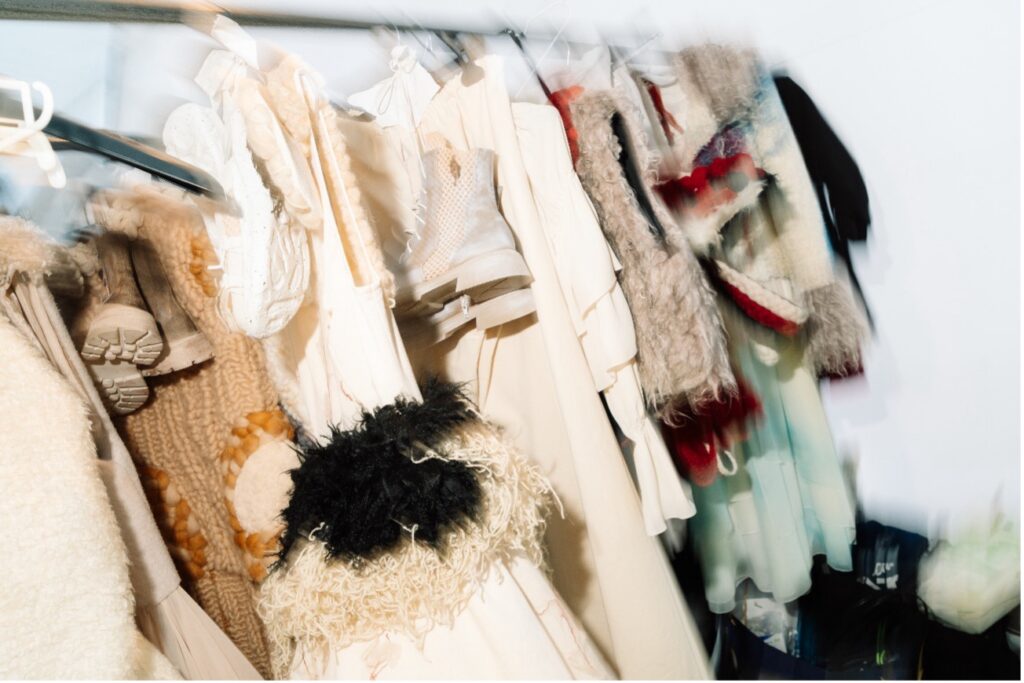
Lessons learned from the 3rd iteration of the Romanian Pilot Aura Mihai, Antonela Curteza, Ramona Budeanu and Dorin Ionesi, Gheorghe Asachi Technical University of Iasi with the support of REGINNOVA Romanian traditional masks reinterpreted by TUIASI students at Romanian Fashion Week On 23 May 2026, during Romanian Fashion Week, students and PhD candidates from the […]
Cultural heritage as a pathway to developing future materials for garments. Trial-and-error in Material Experimentations.
By Malene Pilgaard Harsaae, Ronni Anthony Johannesen, Anne Louise Bang, VIA University College & Jan Julin, Liisa Ronkainen, Outi Räsänen, Oulu University of Applied Science Introduction The fashion and textile industries use substantial amounts of resources to sustain their business models, which are increasingly dominated by fast replacement and low prices. This imposes excessive costs […]
The CRAFT-IT4SD ecosystem: From experimental learning to structured skills creation

By Aura Mihai & Dorin Ionesi, Gheorghe Asachi Technical University of Iasi and Marianne Ping Huang, Adriënne Heijnen, Amalie Storm Ege & Martin Wurzer, Aarhus University About experimental learning through training workshops The transformation of crafts, creative, and cultural sectors across Europe is no longer a matter of heritage preservation alone but of strategic development […]
CRAFT-IT4SD publishes new article on participatory methodologies for sustainable innovation in the European CCSI
The CRAFT-IT4SD consortium is pleased to announce the publication of a new collaborative article titled “Participatory methodologies: How CRAFT-IT4SD built a collective approach for researching and innovating sustainable transitions in the European cultural and creative industries (CCSI).” The publication explores how knowledge can be effectively generated, coordinated, and applied within the European CCSI—one of the […]
WHERE HERITAGE MEETS INNOVATION: CRAFT-IT4SD PILOTS CRAFTING A CIRCULAR AND SUSTAINABLE FUTURE

By Liisa Ronkainen, Oulu University of Applied Sciences, Malene Pilgaard Harsaae and Anne Louise Bang, VIA University College, Juliana Penagos and Lidia Morcillo, MODACC, Aura Mihai and Dorin Ionesi, Gheorghe Asachi Technical University of Iasi and Marianne Ping Huang, Adriënne Heijnen and Martin Wurzer, Aarhus University Short overview of the CRAFT-IT4SD piloting phase CRAFT-IT4SD’s four […]
Future-proofing creativity: developing green, social, and digital competencies for the next generation of crafts and creative industries

By Herman Bashiron Mendolicchio, ECBN & María Cristina Ortega and Arkaitz Celaá Angulo, 3Walks The creative and cultural industries are entering a decisive phase. As environmental urgency, digital acceleration, and social transformation increasingly shape how value is created and shared, the challenge is no longer simply to adapt existing practices, but to anticipate the competencies […]
LET’S FOCUS ON THE SLOW FASHION MOVEMENT: EMBRACING THE 5 R’S OF SUSTAINABILITY

By Liisa Ronkainen. Oulu University of Applied Sciences The idea of “fast” goes beyond fashion; it’s a lifestyle driven by mass production, impulse, and convenience. Fast living in food, fashion, technology, and media prioritizes speed over quality, connection, and sustainability. In contrast, the slow movement values quality, care, and mindful consumption, encouraging us to choose […]
From compliance to integration: Value creation through legislation adoption

By Lidia Morcillo, Juliana Penagos Nigrinis, Clara N. Solé – MODACC European sustainability legislation is reshaping the way the fashion industry operates. What was once a voluntary commitment (sustainable practices) has now become a strategic requirement, redefining expectations for companies across all sectors — and especially for the fashion industry. Image generated with AI Far […]
Tales from the backstage of craft making: Surfacing invisible work for textile craft innovation

By Rune Thorbjørn Clausen & Simon Peter Larsen. VIA University College If one pays a visit to our design school’s craft labs, one will, among others, find a unique infrastructure consisting of multiple workstations for embroidery, weaving, dyeing, finishing, and digital printing. The labs house both analogue and advanced digital textile technologies, including circular and […]
How receptive are craftspeople and designers to adopting digital innovation for sustainability?

By Aura Mihai, Raluca Lupu, Antonela Curteza, Dorin Ionesi, Radu Firicel and Iuliana StrebaGheorghe Asachi Technical University of Iasi Introduction The ISO/ASTM 52900:2021 standard defines 3D printing as a layer-by-layer process that constructs objects directly from 3D model data, distinguishing it fundamentally from traditional subtractive and formative manufacturing methods. 3D printing has emerged as a […]