
By Aura Mihai & Dorin Ionesi, Gheorghe Asachi Technical University of Iasi and Marianne Ping Huang, Adriënne Heijnen, Amalie Storm Ege & Martin Wurzer, Aarhus University
About experimental learning through training workshops
The transformation of crafts, creative, and cultural sectors across Europe is no longer a matter of heritage preservation alone but of strategic development for sustainability, community resilience, and economic opportunities. In this context, the CRAFT-IT4SD project has provided structured, evidence-based case studies and training activities that demonstrate how learning communities can act as catalysts for innovation, skills development, and systemic change.
The initial phase of developing the CRAFT-IT4SD learning community (1st iteration) encompassed a series of training workshops and pilot activities, designed to explore the intersection of craftsmanship, sustainability, and digital innovation. These activities moved beyond mere one-directional interventions and instead centred around building experimental learning environments in which participants engaged in applied, practice-based co-development processes. In Spain, interactive workshops helped SMEs translate sustainability and circularity challenges into technology-supported strategic business opportunities, strengthening decision-making and leadership capacities. In Sweden, co-creation sessions addressed the implications of emerging EU frameworks, such as the Digital Product Passport, linking regulatory literacy with innovation in user experience and product design. In Finland and Denmark, participants explored the use of digital tools (e.g., gamification, NFC technologies) to enhance transparency and consumer engagement within fashion systems, while in Romania, interdisciplinary workshops demonstrated how additive manufacturing and 3D printing can reinterpret and revitalise traditional cultural symbols, enabling an inclusive dialogue between heritage and advanced manufacturing technologies. These training workshops proved to be a highly effective way to bridge gaps and foster innovation across education, research, and industry by establishing experiential, interdisciplinary learning communities within existing ecosystems.
The second iteration of the training workshops focused on deepening the learning community’s capacities by identifying systemic challenges and the corresponding emerging skill needs within the Cultural and Creative Sectors and Industries (CCSI) to drive sustainable transformation. This phase addressed several critical dimensions of the sectoral transition, such as the ability to understand and effectively implement sustainability objectives through impact assessment methodologies, and to leverage digital technologies to enhance transparency, communication, and value creation in micro companies and SMEs beyond their organisational boundaries. Moreover, applications of material-driven design approaches that embed sustainability considerations at early stages of product development were complemented by experimentation with traditional, sustainable materials and digital fabrication, reinforcing the link between innovation and heritage-based practices. These activities generated both valuable learning outcomes and evidence-based insights into the evolving skills landscape, highlighting the need for hybrid competences that combine craft expertise, digital literacy, sustainability knowledge, and entrepreneurial capabilities. Importantly, they also demonstrate that such competences are most effectively developed and transferred through learning ecosystems rather than traditional training models, as these enable continuous interaction, co-creation, and adaptation to real-world challenges.
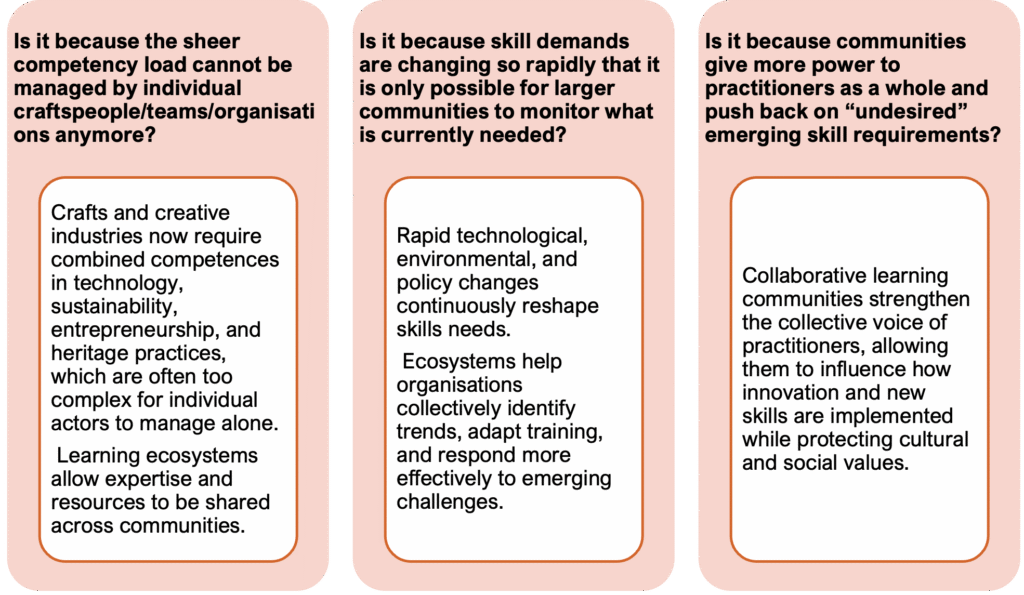
CRAFT-IT4SD shows that an ecosystem approach to learning is effective when more diverse skillsets are needed (technological, environmental, traditional, etc.). It creates dynamic environments where diverse actors contribute complementary knowledge, perspectives, and resources. Such ecosystems support interdisciplinary learning, continuous reskilling and upskilling, and real-world experimentation, enabling more resilient and future-oriented forms of skills development. Rather than treating learning as an isolated activity, the ecosystem approach positions skills creation as a collaborative and systemic process linked to broader societal, technological, and environmental transitions. But why is that? Let’s explore several relevant directions:
Transnational impact of the CRAFT-IT4SD learning community
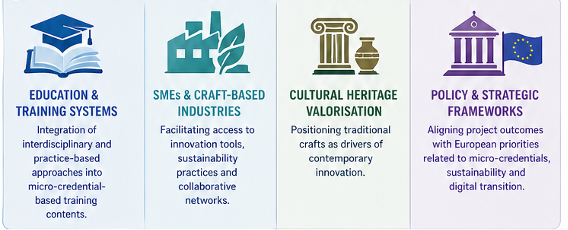
The outcomes of the CRAFT-IT4SD learning community have an impact across partner countries, contributing to the development of emerging skills for crafts, sustainability, heritage, and creativity. The key areas impacted by this approach include:
- Education and training systems, through the integration of interdisciplinary and practice-based approaches into micro-credential-based training contents;
- SMEs and craft-based industries, by facilitating access to innovation tools, digital technologies and platforms, sustainability practices, and collaborative networks;
- Cultural heritage valorisation, by positioning traditional crafts as drivers of contemporary innovation, adopting an ethical and responsible framework
- Policy and strategic frameworks, by aligning project outcomes with European priorities related to micro-credentials, sustainability, and digital transition.
Towards a future-oriented crafts ecosystem
Building on the validated results of the project so far, the next development phase focuses on advancing CRAFT-IT4SD´s learning community by strengthening its structural framework and expanding its integration and impact through cross-piloting initiatives. By transitioning from local learning communities to cross-regional collaborations that integrate sustainability, digitalisation, and living heritage, this phase contributes to the establishment of a more complex and holistic learning model that enables active participation in – and shaping of – the CCSI through boundary-spanning forms of interaction. This approach, therefore, reflects a systemic perspective, where skills development, reskilling and upskilling are not only responsive to labour market needs but also contribute to the transformation and resilience of the culture and creative sectors and industries themselves.
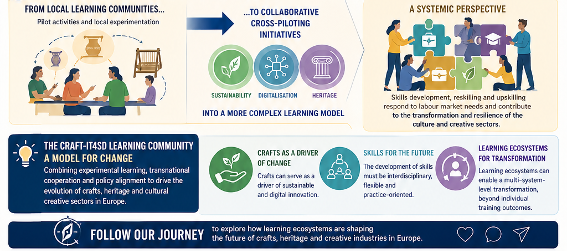
The CRAFT-IT4SD learning community provides a compelling example of how collaborative, ecosystem-based learning models can support the evolution of crafts, heritage and cultural creative sectors. By combining experimental learning, local communities’ good practices and transnational cooperation, , the project demonstrates that:
- crafts can serve as a driver of sustainable and digital innovation;
- the development of skills must be interdisciplinary, flexible, and practice-oriented;
- learning ecosystems can enable a multi-system-level transformation, beyond individual training outcomes.
Join us on a journey to explore how learning ecosystems are shaping the future of crafts, heritage, and creative industries in Europe.
Reference: https://craft-it4sd.eu/