
By Liisa Ronkainen, Oulu University of Applied Sciences, Malene Pilgaard Harsaae and Anne Louise Bang, VIA University College, Juliana Penagos and Lidia Morcillo, MODACC, Aura Mihai and Dorin Ionesi, Gheorghe Asachi Technical University of Iasi and Marianne Ping Huang, Adriënne Heijnen and Martin Wurzer, Aarhus University
Short overview of the CRAFT-IT4SD piloting phase
CRAFT-IT4SD’s four pilots are at the core of the project’s aims to revitalise European craft heritage through digital technologies, to bring craft values into the circular economy, and to facilitate micro-businesses and SMEs in their journey towards enhanced sustainability, circularity, and market access through new business models. The skills, techniques, traditions, and knowledge associated with crafts often inherently reflect circularity and sustainability principles, for example through material reuse, long product lifetimes, local sourcing, and low-waste production methods. This intangible heritage can be reactivated and leveraged through the establishment of new approaches, local best practices, and cross-sector collaboration. For example, the use of digital technologies can enhance value-chain transparency, support knowledge exchange, and enable stronger engagement with customer groups around local products and their embedded cultural values.
Northern Finland Pilot
The second pilot iteration at Oulu University of Applied Sciences (Oamk) focused on combining innovative technologies with craft, performance, and sustainability practices to support SME empowerment and cultural heritage revitalisation. The work centred on three main themes: printed electronics in textiles, immersive visual programming with TouchDesigner, and circular design using upcycled materials. Together, these activities enabled hands‑on experimentation, cross‑sector collaboration, and the creation of tangible prototypes that bridge traditional craft with emerging technologies.
The printed electronics workshops, held at Oamk’s Prinlab, introduced participants, including costume designers, textile entrepreneurs, and sustainability industry representatives, to functional materials, circuit printing techniques, and sustainability considerations such as durability and washability. Participants conducted practical tests on various textiles, explored applications for wearable technology, and co‑designed initial plans for a tech‑enhanced performance costume. The sessions resulted in new professional contacts and sparked two new project ideas; notably, two SMEs (FabPatch and Brightplus) committed to continued collaboration in Pilot 3.
Technical development also advanced through the creation of interactive LED garments, where addressable LED strips, ESP32 microcontrollers, and WLED firmware were tested to achieve a reliable, portable, battery‑powered lighting system for performances. Additional experimentation included LED matrix effects, 3D‑printed enclosures, and sound‑reactive lighting using TouchDesigner and LedFX. Alongside this, Oamk organised an online workshop on TouchDesigner for consortium partners, highlighting the software’s potential for sustainable data visualisation, interactive installations, and performance visuals. Its accessibility and active learning community were emphasised as key benefits for SMEs.
A major circular‑design component was the construction of a performance costume made from reused coffee packaging, applying traditional Finnish weaving techniques. This process demonstrated low‑cost sourcing, minimal waste, and design flexibility through thermoplastic properties, offering clear value for small craft‑based businesses seeking sustainable production models. The resulting piece was featured in the “Sun Wind” performance during the Oulu Plenary Meeting, where motion‑tracked and audio‑reactive visuals were integrated using TouchDesigner.
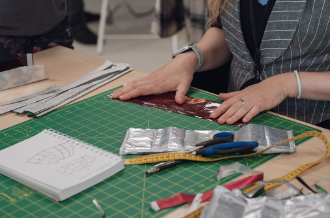

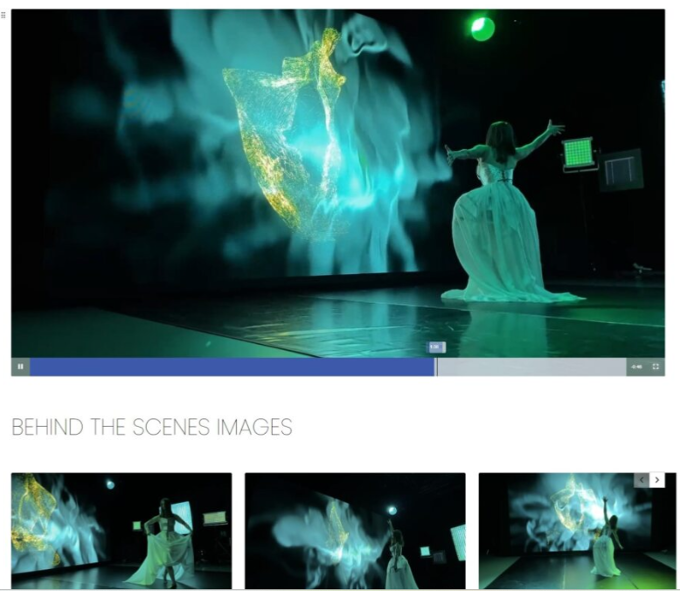
Oamk Pilot – Performance costume – Design, development and tests. Photo credit @Oamk
The pilot contributed significantly to Oamk’s KPI targets by generating new product and service concepts, establishing SME collaborations, and building digital and green skills. The insights gained—including challenges around power sources for wearables and usability issues in the Open Connector platform—will inform future testing in Pilot 3 and the development of WP6 micro‑credential curricula.
Central Denmark Pilot
The 2nd iteration of the Danish pilot has focused specifically on materials from multiple perspectives and approaches, including development, use, exploration, experimentation, revival of traditional recipes and material-driven design as a process model. Practitioners from different micro-companies have worked in digital and analogue weaving, knitting, printing and dyeing labs to experiment and prototype. Micro-companies have explored various aspects of their practices to gain new knowledge and understanding of technologies they generally lack access to.


VIA University College Pilot
The data collection, including observations of their processes, has helped inform and refine the material-driven design process (MDD4AT), which has been central to this iteration. Furthermore, it has provided valuable insights into the working conditions of micro companies and how they combine cultural heritage, craft skills, and digital technology to deliver high-quality, sustainable products to their customers. We use method development and fieldwork as levers to empower micro-sized companies and prepare them to adapt to upcoming EU legislation (digital product pass, circular and sustainable design, extended product responsibility, and more use cycles).
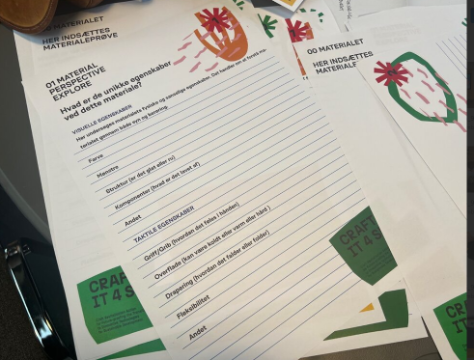

Climathon event at VIA University College Pilot. Photo credit: @VIA
Students have worked both in workshops in larger groups (e.g. at Climathon) and individually to test and provide feedback on the MDD4AT model. Researchers have also worked on various aspects of materials development, including using AI prompting to support print development and exploring the potential of reviving casein as a bio-based ingredient for new sustainable materials.
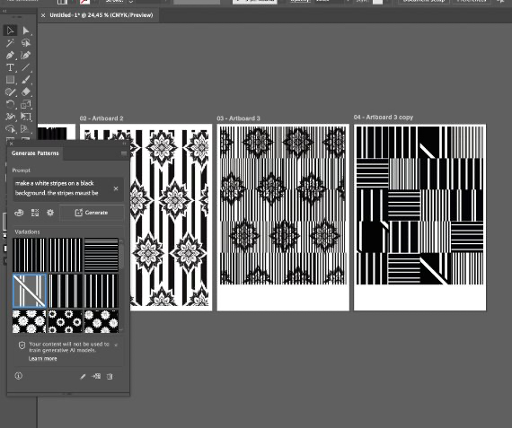

VIA University College Pilot- AI prompting to support print development. Photo credit: @VIA
Romanian North-East Pilot
The second iteration of the Romanian pilot built on and enhanced the insights gained during the first phase, aiming to explore the dynamic intersection of traditional craftsmanship and emerging technology. It further promoted cross-disciplinary collaboration by inviting participants from the first phase—designers, technologists, and creatives—to co-create with students, digital experts and artisans. In this respect, the developers (students and researchers) from the first iterations shared their expertise and experience with a new cohort of students to create a new collection, which was presented at DIMA Fashion Nights in November 2025. Also, this iteration created synergy with another initiative of the TUIASI partner, namely the Junior Designer contest. Within this edition of Junior Designer (2025) and based on the previous experience from the 1st iteration in the CRAFT-4SD project, the new collections feature several models that incorporate additive manufacturing techniques, such as 3D printing, digital embossing, and embroidery, opening new creative possibilities and demonstrating how modern tools can complement traditional craftsmanship.
Additionally, this iteration emphasises interactive storytelling, allowing users to engage with digital narratives that deepen their understanding and appreciation of the pieces. This approach enhances user experience, adds emotional value, and supports more informed and meaningful consumption.
Moreover, in the second iteration, the project team has begun developing the interactive digital fashion show, leveraging advanced 3D design software (3DCLO), Artificial Intelligence (AI), and Virtual Reality (VR) tools to create digital garments. This innovative showcase was enhanced by developing digital avatars and fabric simulations and by prototyping in CLO3D, providing an immersive experience that blurs the line between physical and virtual fashion.
Several lessons stand out after the 1st and 2nd pilot iterations, such as: 1) Digital technologies do not replace tradition, they amplify it, giving new life to symbols and practices that might otherwise fade; 2) Collaboration between artisans and engineers is not optional but essential, since authenticity and innovation can only thrive together; 3) Sustainability is more than a buzzword: by combining regional fibres with additive manufacturing, the pilot showed that ecological responsibility can be embedded in design. 4) Finally, education across disciplines emerged as the key to the future of the creative industries, as students moved seamlessly between cultural research, engineering challenges, and design thinking.


TUIASI@REGINNOVA Pilot: 3D digital prototype and the real prototype @ photo credit:TUIASI
Catalonian Pilot
The second iteration of the pilot in Catalonia/ Spain focused on developing a practical roadmap to support SMEs’ adaptation to a selected set of sustainability norms, using impact measurement tools as enablers. Activities during this phase included in person workshops with relevant SMEs from the ecosystem, which led to the translation of regulatory requirements into actionable steps that provided SMEs with concrete guidance on implementation pathways. The resulting roadmap, made available as an open-access resource, represents a tangible impact of the pilot, supporting not only direct participants but the wider ecosystem. This iteration shifted the pilot from awareness-raising to operational support, reinforcing SMEs’ ability to plan and respond to legislative integration.
The current iteration aims to deepen understanding of existing sustainable business models within the Catalan ecosystem, their perceived value by different actors, and their alignment with current and upcoming legislation. By analysing real practices rather than theoretical models, the pilot generates evidence on what is already working, where gaps remain, and evaluates if policy and support instruments are aligned with SME realities. This iteration is expected to strengthen the relevance of the overall pilot activities by linking business model innovation directly to regulatory frameworks and long-term sustainability objectives.


Concluding Remarks
The CRAFT-IT4SD piloting phase explores how European craft heritage can be revitalised through the strategic integration of new technologies, circular design principles, and innovative business models. Across four regional pilots in Northern Finland, Central Denmark, North-East Romania, and Catalonia (Spain), the project investigates how the intangible knowledge embedded in local craft traditions can support sustainability, transparency, and resilience within micro-businesses and SMEs. Each pilot applies a place-based, practice-led approach, combining traditional craft skills with digital tools such as printed electronics, immersive visual programming, additive manufacturing, material-driven design processes, and impact-measurement frameworks. Moreover, through ongoing knowledge sharing, the insights generated are transferred across all pilot sites and contribute to strengthening the sector beyond the local pilot ecosystems.
The pilots demonstrate pathways through which digital technologies do not replace traditional craftsmanship but instead amplify its cultural, environmental, and economic value. Through cross-sector collaboration among artisans, designers, technologists, researchers, and students, the piloting phase generated tangible prototypes, new product and service concepts, and adaptable methodologies supporting circular material use, sustainable production, and enhanced market access. Furthermore, the pilots provide evidence-based insights into how SMEs can align heritage-based practices with emerging EU sustainability regulations and digital requirements.
Overall, the CRAFT-IT4SD pilots highlight the transformative potential of combining craft heritage, technological innovation, and circular economy principles. By embedding sustainability within cultural practice and fostering interdisciplinary education and collaboration, the project contributes scalable models and actionable knowledge to support the future competitiveness and sustainability of Europe’s craft-based creative industries.