
By Malene Pilgaard Harsaae, Ronni Anthony Johannesen, Anne Louise Bang, VIA University College & Jan Julin, Liisa Ronkainen, Outi Räsänen, Oulu University of Applied Science
Introduction
The fashion and textile industries use substantial amounts of resources to sustain their business models, which are increasingly dominated by fast replacement and low prices. This imposes excessive costs on the environment, both in the extraction of a variety of resources and in the processing of these into materials that can be used for products. Materials from the extraction and processing of resources in tier four—such as agriculture and fossil fuels—constitute an integral part of material intake in the fashion and textile industries as cotton and polyester stem from these sources. There is a need to explore alternative resources for the fashion and textile industries to develop materials and material solutions for the future, which are less environmentally harmful alternatives to conventional resources. In the light of this, CRAFT-IT4SD has initiated several material experiments to explore the relevance of cultural heritage in contemporary material development. Here we introduce two quite different lines of exploration, 1) exploring the use of casein at the Danish pilot site (VIA University College), and 2) exploring the use of fish skin at the Finnish pilot site (Oulu University of Applied Science). We aim to discuss cultural heritage as a foundation for a series of trial-and-error design experiments.
The Casein Case, Danish Pilot Site
The point of departure for this project is desk research into former use of casein to investigate the potential for developing future contemporary materials for garments. Previously use of casein as an ingredient for material development has involved the use of harsh chemicals. This project explores 1) if current technologies enable material development without the need for contaminating chemicals, and 2) the possibilities of using casein to create materials with sufficient flexibility for clothing products. The project explores casein as resource for developing new casein-based materials as well as for coating existing materials (e.g. deadstock, shredded textile waste). Subsequently, a fashion designer explores the 2D material prototypes and the potential for implementing in 3D clothing products. Materials developed with casein have properties differentiating from conventional materials, especially in relation to tactility, consequently the fashion designer initiated the process by exploring the material through material driven design using the MDD4AT model (Harsaae et al., 2025). The first material samples were small scale; the fashion designer thus worked with shape experiments on a 1:10 size dummy. Following the evaluation of the material potential, bigger sheets are produced for further design development. Finally, the most promising materials in terms of use and implementation, have been exposed to consumers to explore their reactions. This was done in collaboration with the bio-metric lab researchers and involves the development of a novel approach to register consumer reactions to touch.
A historical glimpse on casein
Casein originates from the use of leftover or surplus material in the production of milk. Historically, casein was used as a glue and binder in paint. It was later discovered that the combination of casein and formaldehyde allowed the material to harden and create a hard, mouldable plastic, and by the early 20th century it was used in the mass production of plastics (Plastiquarian, n.d.). Casein has been used as a replacement fibre for wool and silk in the production of yarn, but the use of casein was phased out in the 1970s due to high production costs and replaced with synthetic fibres (TextileToday, 2018). Currently, there is a renewed interest in the potential of using casein due to environmental concerns and the related interest in biomaterials.
Experimenting with casein
The point of departure was to adjust a traditional recipe for casein development by replacing the former use of harsh chemicals as formaldehyde with more environmentally friendly ingredients. This was executed as several trial-and-error lab experiments focusing on adjusting the proportions between the ingredients consisting of casein (milk protein), water, baking soda, and glycerine. The different experiments were produced in an A5 mould to create comparable test samples. Next step was experimenting with softening the casein before dissolving it with water. It resulted in a surface with many bubbles, and different tools were tested to reduce/remove the bubbles, including a hand mixer, a dough scraper and a magnetic heat mixer. Progress method included evaluating the amount of glycerine between 1-8 ml to 100 ml water. 1 ml turned out as too little as the material became too stiff and broke. After several trials-and-error experiments, 6 ml glycerine to 100 ml water was the most optimal solution. This series of experiments was followed by experiments with red wine tannins to compress the material.
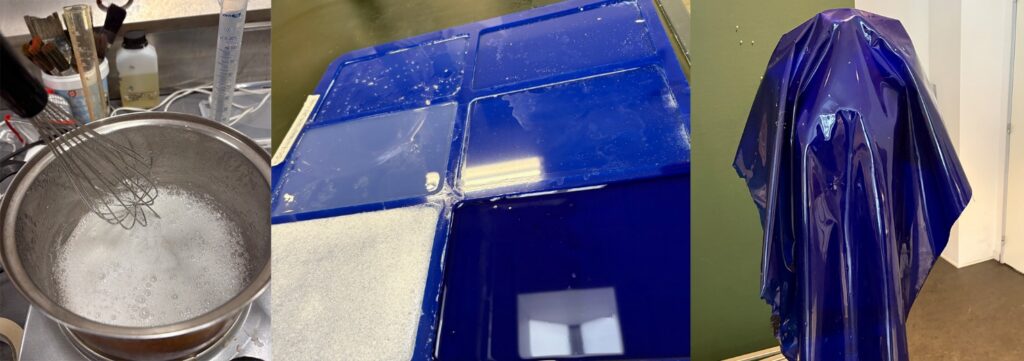
Figure 1. Casein experiments. Development & photos: Ronni Anthony Johannsen, VIA University College
Transferring the DIY recipe to bigger scale experiments included several experiments in relation to amounts and proportions together with test of relevant tools to avoid bubbles in the final material. Similarly, temperatures of the casein mass were tested with the intention of reducing time in the drying process. Further experiments focused on combining casein with a variety of leftovers including textile scraps, potato peel, and mandarin peel. Parallel to the fashion designers’ form experiments on the dummies, the material designer developed moulds with different shapes to create pre-shaped garment pieces glued together with a fluid casein solution.
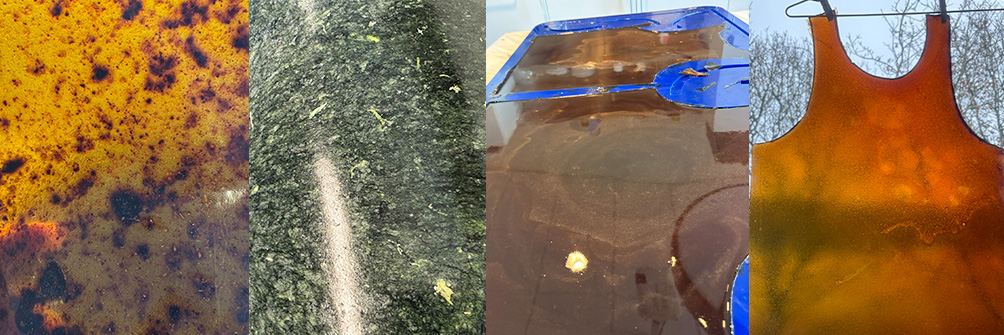
Figure 2. Casein experiments with leftovers and moulds. Development & photos: Ronni Anthony Johannsen, VIA University College
The Fish Skin Case, Finnish Pilot Site
Humans have used animal hides since prehistoric times for clothing, shelter, and tools, forming an essential element of early material culture and survival. Archaeological evidence, including scrapers made from stone, bone, and antler, demonstrates long-standing practices of skin preparation and leatherworking (Rahme, 2021). In addition to meat, ancient societies utilized various animal by-products such as hides, bones, and sinews, transforming them into practical items including tools and protective garments. Initially, hides were treated using simple methods such as drying and mechanical softening, which involved cleaning and manually working the skins to maintain flexibility (Rahme, 2021). Over time, tanning techniques developed through experimentation, leading to more durable and functional materials. Early tanning methods included oil and smoke tanning, both of which enhanced the longevity and flexibility of hides. Vegetable tanning later emerged as a significant advancement, with archaeological evidence indicating its use in Egypt over 5000 years ago (Rahme, 2021).
A historical glimpse on fish skin
Although tanning practices were widespread globally, the use of fish leather appears particularly characteristic of Arctic and sub-Arctic regions. Fish skin has historically been a valuable material in societies located along rivers, coasts, and streams, where it was used to produce garments such as parkas, boots, mittens, and hats (Rahme, 2021). In these environments, Indigenous communities, including the Sámi, Inuit, and other northern peoples, developed sophisticated tanning methods adapted to locally available resources, and the knowledge of these techniques has been preserved across generations (Rahme, 2021). While Sámi traditions are often more strongly associated with reindeer hides, fish leather also played a role in local material culture. More broadly, across Arctic regions such as Alaska, Siberia, and northern Scandinavia, the processing of fish skins reflects a resource-efficient and sustainable approach to material use, where all parts of the animal were utilized. This perspective aligns with contemporary interest in fish skin as an underused by-product of food industry with strong potential as a sustainable material (Rahme, 2021).
Experimenting with fish skin
This study explores the revival of traditional fish skin tanning as both a cultural practice and a sustainable material innovation for stage costume design. The project aimed to experiment with cleaning and tanning fish skin using accessible methods, to integrate fish leather into modern performance wear, and to make creative use of waste/surplus materials typically discarded in food production. Because of seasonal and time constraints, fat tanning was selected as the primary method, given its practicality and the ready availability of suitable raw materials. Fish skins were sourced free of charge from a local supermarket’s fish counter.
The tanning process began with extensive manual cleaning, using simple tools such as blunt knives to remove scales, fat and organic residues. This step proved to be the most demanding, as incomplete cleaning caused persistent odor in several samples and ultimately led to material loss. After cleaning organic waste and washing the skin with mild soap, skins were treated in a fat based tanning mixture and dried slowly before softening through rehydration, oiling, and mechanical manipulation. The skins were treated with bee wax and stretched and rolled simply with hands and also against plastic kitchen utensils, which replaced traditional animal bones. The resulting leathers exhibited notable differences between species: salmon skin remained relatively paper like despite repeated softening attempts, while burbot produced the most pliable, soft, and leather like material. As the process was done all by hand and without machines, the next potential step would be to scale the process up to larger quantities of fish skins and testing the skin manipulation by machines.
Overall, the project demonstrated that fat tanning is an accessible and effective technique for producing surprisingly durable, strong, and lightweight fish leather. The technique also left no residue, as all the materials used for the curing were normal food items such as eggs and rapeseed oil combined with dishwashing liquid. The tanned material was easy to cut and sew, and its edges required no additional finishing, enabling straightforward integration into costume construction. The project also highlighted the inherently experimental, trial‑and‑error nature of the process. Several insights, such as species‑specific behavior, humidity sensitivity, oil-egg ratio, and the consequences of incomplete cleaning emerged only through repeated testing, failures, and adjustments. These observations underline both the potential and the practical challenges of reintroducing this traditional craft into modern design contexts.
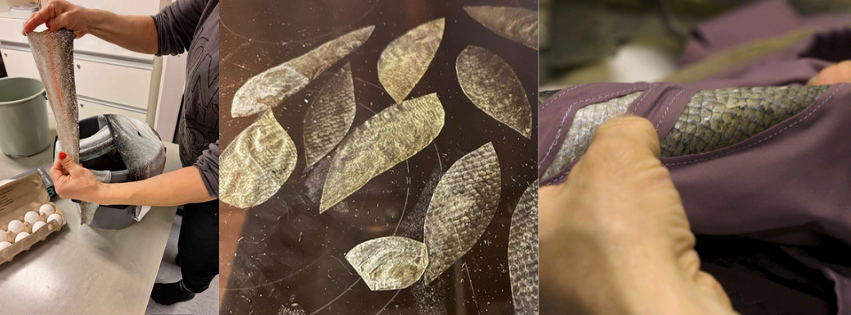
Figure 3. Fish skin during oil-based tanning, as ready-to-use material and integrated into the outfit. Photo credits Erja Taskinen and Outi Räsänen.
Concluding remarks
In design research experimentation is acknowledged as a significant element in the development process and ”[…]design experiments in various forms […] play a central role for knowledge generation and theory-building in research through design or practice-led design research” (Bang & Eriksen, 8.2:2013). For both projects the trial-and-error approach has been guiding the development process. In the cases described above it is evident that the success of the experimentation is conditioned by the knowledge and skills possessed by the practitioners that enables them to enter ‘a conversation with the materials of the situation’ (Schön, 1983) and to evaluate through trials and errors. The iterative process provided an extensive number of prototypes each of which contributing to drive the design process forward as ‘carriers of knowledge’ (Stappers 2007). Experimentation, iterative prototyping and learning through trial-and-error are elements grounded in a design process. Elements that are similarly emphasized from various fields as some of the core elements in design thinking (Micheli et al., 2019; Verganti et al., 2021; Magistretti et al., 2025).
One of the ambitions of CRAFT-IT4SD is “to revitalize knowledge, practices and traditional techniques as shared cultural resources for sustainability […]”. The two projects presented in this paper address cultural heritage by drawing on previously generated knowledge and experiences through research into past uses of their respective areas of interest, casein and fish skin, and thus contribute to revitalize knowledge in new cultural contexts. The casein project explored the extent to which the past use of harsh chemicals was avoidable in a contemporary context, the fish skin project focused on the past use of fish skin as a central material for product making, including clothing and accessories. The trial-and-error approach has contributed to enable the experimentation process in transferring traditional recipes and approaches to contemporary contexts.
References
Bang, A.L. & Eriksen, M. (2013). Experiments all the way in programmatic design research. art 6 (1+2) pp. 8.1–8.20 Intellect Limited
Harsaae, M.P., Jaakkola, T., Bang, A.L. (2025b). MDD4AT. Material Driven Design for Apparel & Textiles. https://webpagefilestorage.blob.core.windows.net/webpagefilecontainer/MDD4AT%20Milestone%20Report.%202025.12.16.pdf
Magistretti, S., Dell’Era, C., Candi, M., Swan, S. K., Bianchi, M., Calabretta, G., Stigliani, I., Verganti, R. (2025). Unpacking experimentation in design thinking: Contributions to innovation performance and the moderating role of digital technologies, Technovation, Volume 141,
Micheli, P., Wilner, S.J., Bhatti, S.H., Mura, M., Beverland, M.B., (2019). Doing design thinking: conceptual review, synthesis, and research agenda. J. Prod. Innovat. Manag. 36 (2), 124–148.
Plastiquarian, The Plastics Historical Society (n.d.). https://plastiquarian.com/?s=casein
Rahme, L. (2021). Fish skin, a sustainable material used from ancient times to today’s fashion. FormAkademisk, 14(2), 1–16. https://doi.org/10.7577/formakademisk.4183
TextileToday (2018). Properties, production and use of milk fiber. https://www.textiletoday.com.bd/properties-production-use-milk-fiber
Verganti, R., Dell’Era, C., Swan, S., (2021). Design thinking: critical analysis and future evolution. J. Prod. Innovat. Manag. 38 (6), 603–622.